
Home / Solutions / Highways & corridors / Tunnel Systems
Highways & corridors
Tunnel Systems
Detection, signs, communication and control that work together when something goes wrong underground.
Conceptual workflow
- 1Detect
- 2Confirm
- 3Act
- 4Inform and clear
Illustration of the principle. Not a specific site or product.
Overview
What this solution delivers.
In a tunnel an ordinary incident becomes serious quickly. A stopped vehicle blocks a lane with no shoulder, smoke has nowhere to go, and drivers cannot see what lies ahead.
Tunnel systems are designed as one. Detection finds the incident, the control system proposes a response plan, and signs, barriers, ventilation, lighting and announcements act together under the operator. We integrate the traffic and communication systems and their interfaces to the tunnel plant.
Typically for: road authorities, tunnel operators, design consultants and main contractors.
At a glance
Every part of the system, in one picture.
Select a label to see what each device does. The 3D model below follows the system step by step.
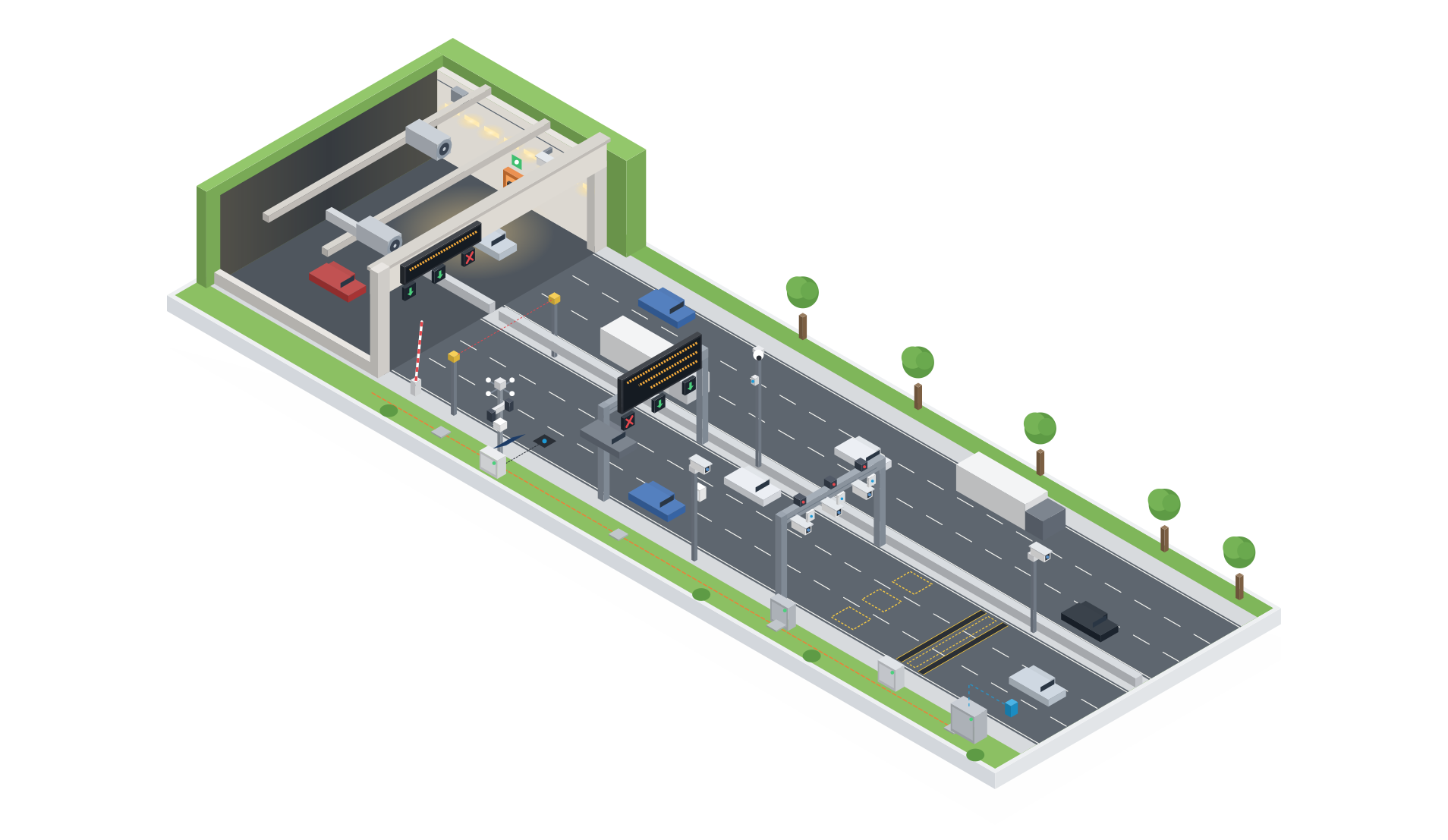
Select a label
Tunnel Systems
Every labelled part of the drawing is a device the system connects. Select one to see what it does.
Monitored and switched through the plant interface from the control room.
Video detection flags a stopped vehicle, smoke or a wrong-way driver.
Lets anyone in the tunnel speak to the control room.
Close a lane in the tunnel when a vehicle has stopped in it.
Stops traffic entering the tunnel during an emergency.
Warns drivers before they enter the tunnel.
Controlled through the tunnel plant interface as part of a response plan.
Rebroadcast radio and announcements tell people what to do.
Illustration. Generic equipment, not a specific home, site or product.
How it works
Follow the system, step by step.
Select a numbered point or a step. Drag the model to look around.
Drag to rotate · pinch or use + and − to zoom
Illustrative model. Generic equipment, not a specific site.
Challenges
What typically goes wrong.
Seconds matter
A stopped vehicle or smoke must be noticed before following traffic arrives.
Many systems, one response
Signs, ventilation, lighting and announcements must change together.
Operator overload
In an incident the operator faces many screens and many alarms.
Hard to maintain
Access for maintenance means closing lanes, usually at night.
What we offer
What the scope can include.
Each project is scoped to its site. These are the parts we design, supply, integrate and maintain.
- Video surveillance and automatic incident detection
- Lane control signals and variable message signs
- Variable speed limits and closure barriers at portals
- Emergency telephones and help points
- Radio rebroadcast and public address
- Over-height vehicle detection before the portal
- Monitoring and control interfaces to ventilation, lighting, power and fire systems
- Tunnel control centre with response plans
Technology categoriesVMS / DMS / LCSTraffic detection & sensorsSoftware & platforms
Benefits
What changes for the people who run the site.
Earlier detection
Incidents are presented to the operator as they happen.
A coordinated response
One plan moves signs, plant and announcements together.
Clear guidance for drivers
People in and before the tunnel are told what to do.
A full event record
Each incident is logged with video, actions and times.
Related solutions
Solutions that share sectors, settings or functions with this one.
 Urban mobility
Road Safety
See risk earlier. Warn drivers sooner. Keep the evidence sound.
Explore solution Highways & corridors
Highway & Road ITS
Inform drivers, detect incidents and manage lanes on high-speed routes.
Explore solution Urban mobility
Urban Traffic Management
Coordinated junctions and corridors, supervised from one operating picture.
Explore solutionAlso listed underTraffic & TransportationHighways & TunnelsMessage Signs (VMS)Incident DetectionControl Room Integration
Questions
Common questions.
Do you supply the ventilation and fire systems?
Those are specialist mechanical and fire packages. Our scope is the traffic, communication and control systems, and the interfaces that let all tunnel systems respond together.
Which make of equipment do you use?
Equipment is selected against the project specification and confirmed at design stage.
Discuss tunnel systems for your project.
The request opens with this solution already selected.