
 Featured solutionHighway & Road ITS
Home / Solutions / Urban mobility / Bus & Emergency Vehicle Priority
Urban mobility
Bus & Emergency Vehicle Priority
Signals that recognise an approaching bus or emergency vehicle and adjust the green to let it through.
Conceptual workflow
- 1Request
- 2Decide
- 3Serve
- 4Recover
Illustration of the principle. Not a specific site or product.
Overview
What this solution delivers.
A bus held at every red light cannot keep its timetable, and an emergency vehicle forced through a red junction puts its crew and other road users at risk.
Priority systems let the signal controller know a vehicle is coming. For a bus, the controller extends a green or brings it forward within agreed limits. For an emergency vehicle, it clears the approach and holds conflicting movements. Afterwards the junction returns to its normal plan.
Typically for: road and traffic authorities, public transport operators, emergency services and traffic engineering consultants.
At a glance
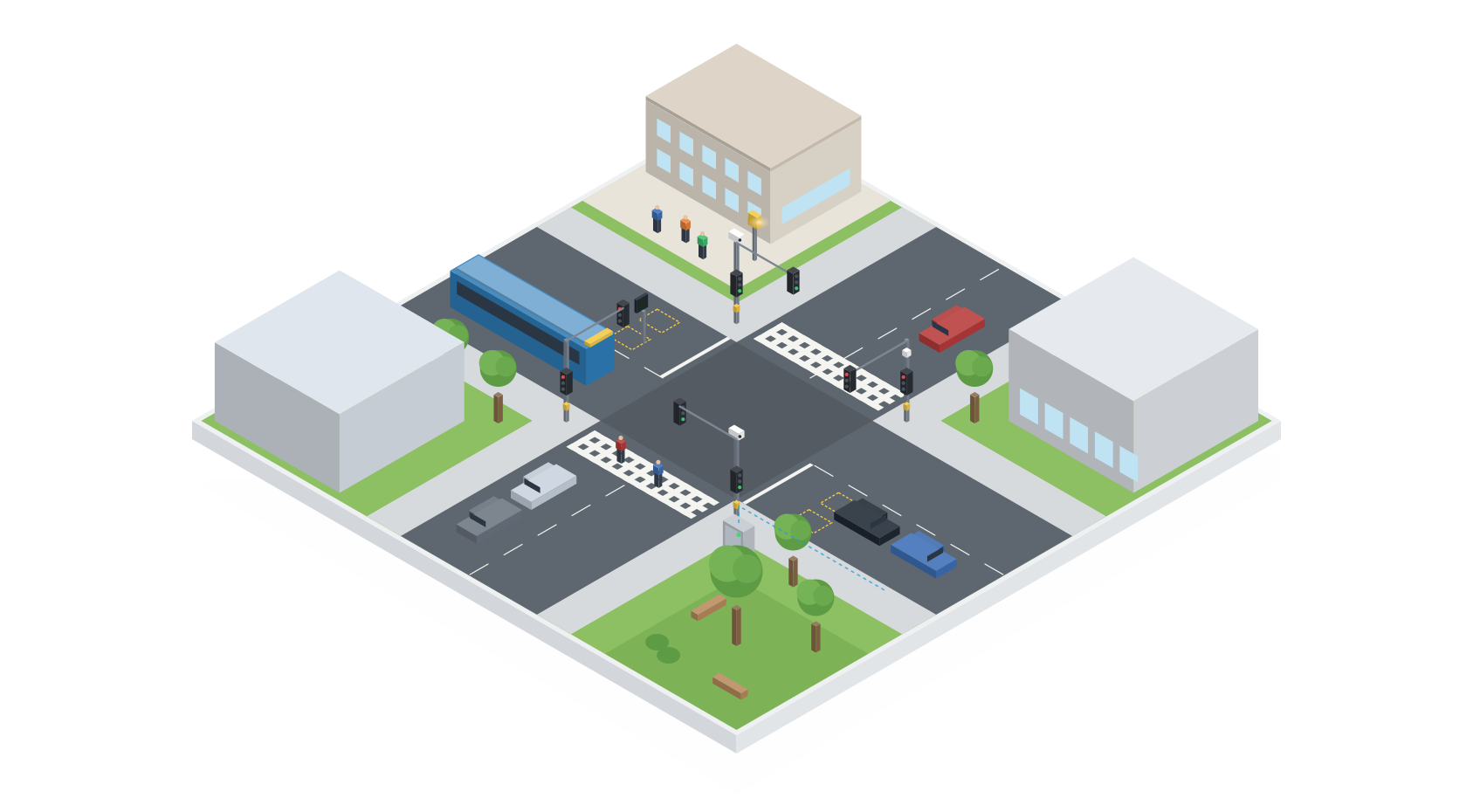
Every part of the system, in one picture.
Select a label to see what each device does. The 3D model below follows the system step by step.
Select a label
Bus & Emergency Vehicle Priority
Every labelled part of the drawing is a device the system connects. Select one to see what it does.
Confirms the vehicle as it reaches the junction.
Records each request so the priority can be reviewed.
Extends or brings forward the green for the approaching vehicle, then returns to normal.
Give the green to the approach with the priority request.
Tells the junction that a bus or an emergency vehicle is approaching.
Illustration. Generic equipment, not a specific home, site or product.
How it works
Follow the system, step by step.
Select a numbered point or a step. Drag the model to look around.
Drag to rotate · pinch or use + and − to zoom
Illustrative model. Generic equipment, not a specific site.
Challenges
What typically goes wrong.
Late buses
Signal delay makes journey times long and unreliable.
Risky crossings
Emergency vehicles enter junctions against a red signal.
Side-road delay
Priority given without limits builds queues on other approaches.
Mixed fleets and controllers
Vehicles and junctions from different periods use different equipment.
What we offer
What the scope can include.
Each project is scoped to its site. These are the parts we design, supply, integrate and maintain.
- Corridor and junction study
- On-board priority units for buses and emergency vehicles
- Roadside receivers and approach detection
- Priority logic in signal controllers
- Central priority management and rules
- Interface to the bus location and fleet system
- Event logging and performance reports
Technology categoriesTraffic signal systemsControllers & cabinetsCommunication & networking
Benefits
What changes for the people who run the site.
More regular buses
Priority is designed to help buses keep to time at signals.
Safer emergency passage
Crews approach a junction that is being cleared for them.
Controlled side effects
Limits and recovery rules protect the other approaches.
Measured performance
Every request and response is recorded for review.
Related solutions
Solutions that share sectors, settings or functions with this one.
 Urban mobility
Urban Traffic Management
Coordinated junctions and corridors, supervised from one operating picture.
Explore solution Urban mobility
Road Safety
See risk earlier. Warn drivers sooner. Keep the evidence sound.
Explore solution Urban mobilitySchool Zone & Pedestrian Safety
Signs, signals and detection that make drivers slow down where children and pedestrians cross.
Explore solutionAlso listed underTraffic & TransportationGovernment & Public SafetyUrban RoadsBus Stops & DepotsTraffic Signal Control
Questions
Common questions.
Does bus priority delay other traffic?
It can, slightly, if it is unlimited. That is why priority is conditional: limits on extension, rules such as serving only late buses, and a recovery step. The effect on every approach is measured during the trial.
Will it work with existing signal controllers?
It depends on the controller type and its software. We survey each junction and state which controllers can be configured, which need an upgrade and which need replacing.
Discuss bus and emergency vehicle priority for your network.
The request opens with this solution already selected.